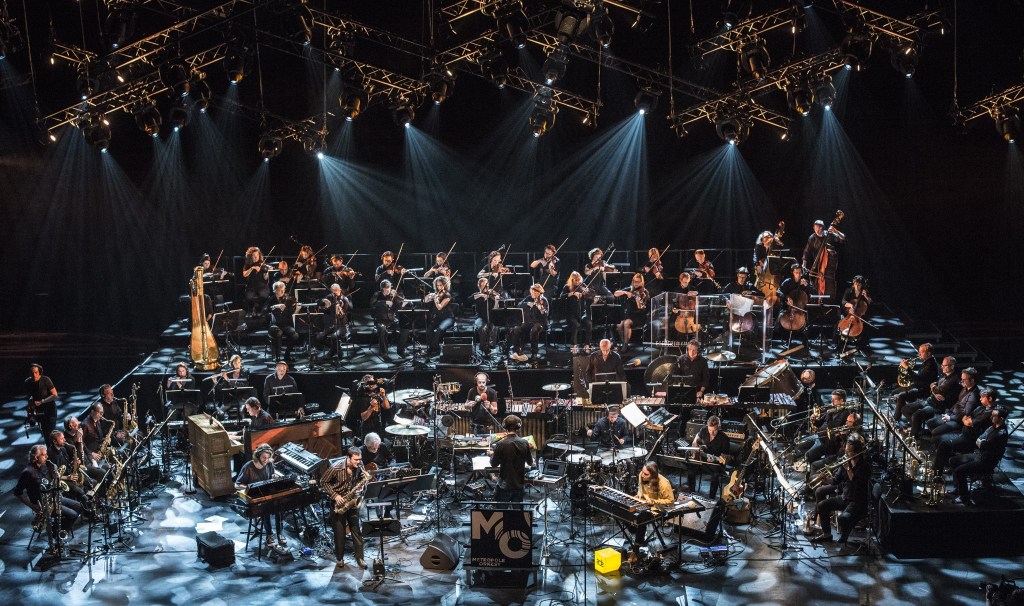
| Album | Sylva |
| Artist | Snarky Puppy & Metropole Orkest |
| Released | 20 April 2015 |
| Highlights | Atchafalaya, The Curtain, Gretel |
| Lowlights | [None] |
| Undertone rating | 5/5 |
Forget Oliver Tree, I’ve got another confession: I’ve never really liked classical music. I’m someone who needs a hook, a bass line, a groove and whilst classical music can have its moments, for me it’s always been too meandering and too inaccessible without a singer to guide me through. After all, what’s the point of music if you can’t really sing or dance to it? It’s not just that though – jazz can certainly be meandering and inaccessible for many, yet it’s a broad genre that I love. But it has something crucial that classical music lacks – improvisation. An improv violin solo would probably sound great but somehow after centuries worth of composers, no one seemed bold enough to do it. Solos and individual expression are a huge part of why I love music. They’re incredibly exciting to hear (and play) live, and also tune in to the personal side of the musician that classical music completely neglects. If every orchestra sounds more or less the same, and every musician is forced to submit to the dots and squiggles of the infallible composer, a good deal of what makes music such a brilliant art form is lost. I’ve never quite managed to get over that.
Enter Snarky Puppy. Improvisation is one of this band’s forte’s (and I mean forte – I’ve spent many happy hours blasting out the funk-rock finales of huge Snarky tunes like Shofukan, What About Me? and Chonks). Led by remarkably humble bassist and composer Michael League, Snarky have long been in a league of their own when it comes to American jazz fusion (pun intended). They’ve literally grown and grown, with the current roster boasting 19 members, meaning they’ve left ‘band’ territory and become a ‘collective’. I could talk about their hits, in particular those from their brilliant 2014 album We Like It Here, for many paragraphs, but I’ll keep it simple – they’re an incredible band. The musicianship and technical ability of all the members is astounding, let alone League’s tight compositional style, which often gets overshadowed by big solos from beasts like Cory Henry and Larnell Lewis. Whilst I may be a big fan, I was yet to delve into more than just We Like It Here and their most recent album until I read online that many fellow fans regarded their (no-less-than Grammy-winning) 2015 release, Sylva, as undeniably their best. It was time for a long-overdue listen.
Sylva is a collaboration with Metropole Orkest, who themselves have nearly 100 musicians in their arsenal. They’ve made a name for themselves as probably the world’s most versatile orchestra, feeling equally at home with contemporary jazz, big band and classical music, and have recently collaborated with modern jazz virtuoso Jacob Collier on his wild and wacky Djesse Vol. 1. The orchestra is even equipped with a “double rhythm section” – one for pop and one for jazz – but both groups had the night off on the recording of Sylva.
The album is a tour through six forests, and almost instantly on hearing the opener, Sintra, League’s first forest begins to materialise vividly. Cold, bleak cellos and a brooding strings ostinato sound eerily similar to the main titles of Stranger Things (although Sintra pre-dates the Netflix series). It’s only a minute or so in when the real heat of this forest becomes apparent (presumably Portugal’s Sintra region), but the mystery remains. You can feel the foggy trees and the secluded pools of black water being conjured up before your ears – such is the magic of Sylva.
An air of slightly frightening intrigue persists throughout much of the album. Moog leads and a woodwind section complement each other surprisingly well on the groovy Flight. The basslines are fuzzy and the sax solo is monstrously altered with the effects, but the disgust only makes the song’s musical direction more intriguing; what’s on the other side of this solo? The destination, it turns out, is rural Louisiana, or more specifically the swamp of the Atchafalaya river basin. This is less Stranger Things and more The Jungle Book, with a King Louie of a brass section stomping its way through the waters and swinging through the canopy. It’s essential listening for fans of super punchy big band music, and even features a gravelly trombone solo and the occasional shout of encouragement from hyped-up band members. Listen to it on high volume and you’ll be shouting with glee too.
And yet, the best is yet to come. The fourth movement, The Curtain, is a much more tranquil, more enchanting place, but still the foreboding remains. The opening strings evokes sunshine through the leaves, but bliss is interrupted by pounding toms that seem to herald an incoming storm. However, there’s still time for an exquisitely played smooth jazz trumpet solo from Mike Maher before the thunder eventually arrives in the form of a razor-sharp electronic bass drop. A heavy brass section lumbers over a bass-heavy funk groove before the dirtiest bass solo you’ll ever hear; Michael League is in his element and you can almost hear the near-ridiculous ‘bass faces’ being pulled as League’s ideas become more and more wonderfully distorted and out of time. There’s a short interlude before the funk onslaught continues, this time with a synth solo from the greatest living keyboardist I know of, Cory Henry. This is the sort of keyboard solo I live for – detuned a quarter-tone, with Henry abusing the pitch and modulation wheels before finally landing on a ridiculously high long note. It’s a solo to be savoured.
But, once the orchestra has wrapped up Henry’s solo, something magical happens. The dust settles and the orchestra and band falls completely silent except for Bill Laurance. What follows is nothing short of magical: a stunning classical piano solo, with every key and touch of the pedal executed with absolute precision. The melodies and chord progressions are utterly beautiful, and you can almost feel the whole room of 80-odd professional musicians and audience members hold their breath with you. After the drama of the previous few minutes, the serenity of Bill’s playing is framed as a moment of beauty within chaos: a chink of sunlight, a rose in a warzone. Laurance builds and League and the two other keyboardists Cory Henry and Justin Stanton harmonise perfectly with him in a gorgeous waltz through the forest. It’s a wordless moment of pure peace in the centre of an mostly very loud album that is enough to bring me to tears. When it’s over, a whispering strings section gives you time to find the tissues before hitting you with an expansive melody rising like a sunrise above timpani and cymbals. Even the most stubborn classical music haters will be in awe.
Gretel is next to arrive, and brings a whole new world of mystery and darkness. It’s perhaps Sylva at its most cinematic, and would be worthy of the next big Christopher Nolan mind-bender. A sighing orchestral melody seems to grow closer and closer before it hits you right in the face with a series of cavernous stops that deserve the justice of being heard on the biggest pair of headphones you can find. At one point Justin Stanton places a key-bass drop in the middle of one of these stops, with the eerily vivid effect of a plane nose-diving and exploding into flames on impact. Total destruction never sounded so awesome.
The Clearing is the 20-minute closing movement and provides some form of resolution from all the tension of the previous track. Metropole Orkest establishes the main theme before Snarky Puppy takes charge with a slinky, laid back jazz groove. It’s a compositional masterclass in giving each instrument enough space to thrive in, and the bass and organ are very careful not to tread on each other’s toes. With the album drawing to a close, League hits us with the greatest bassline of the lot, doubled by Laurance on piano. It’s a killer hook in itself, and has been bashed out lots by me at home as soon as soon I got my fingers around it. Strings enter for a final return of the theme, all the dozens of instruments playing in a jubilant, satisfyingly sure-footed conclusion after a wild ride of an album. Stick around after the applause and you’ll be treated with another few minutes of that bass riff, with an even better solo in the form of Mark Lettieri’s squiggly guitar.
Sylva has achieved something I thought impossible a few weeks ago – it’s an hour of (largely) classical music that I find truly thrilling. And not just that – Sylva has more world-building than a Pullman novel, with each forest presenting it’s own little corners of natural beauty and monstrosity, classical and funk, just as unpredictable and unrefined as reality. There’s shadows in Sintra, giant splashes of water in Atchafalaya, imposing cliff tops in Gretel and, in the centre of it all, a jewel hidden behind the stormy barrier of The Curtain. I don’t need images or even any words: Sylva is an hour of instrumental music that can take me to another world just as well as an engrossing novel or feature film.
The hooks, bass lines and groove are all that you can expect from League at the top of his songwriting game, and the Metropole Orkest add a majesty and depth far more compelling than even the most virtuosic Snarky-only albums. Almost by definition, a funk band playing alongside a symphony orchestra shouldn’t work, but – largely through some arranging wizardry from League – Sylva is a near-perfect marriage of two of music’s most disparate genres.
 Undertone
Leave a comment