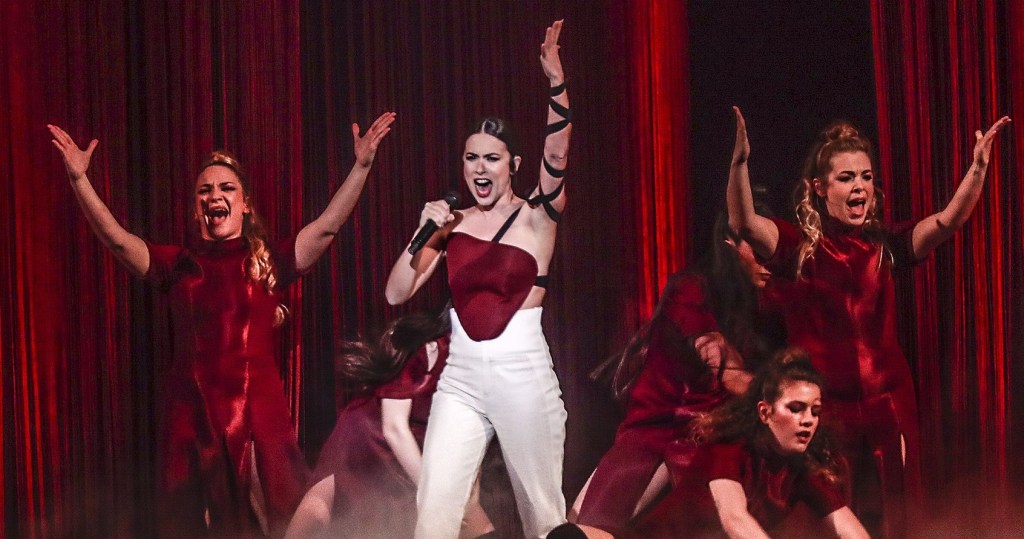
It’s Eurovision season again, and this year feels special: it’s the first contest to be held in my home country of the UK during my lifetime. Sam Ryder’s soaring pop track SPACE MAN didn’t quite win it last year, but still seemed to mark a turning point in recent British results at the contest with a quite remarkable second place finish, securing the UK as hosts since runaway winners Ukraine are unable to host a giant, multi-million euro music event for obvious reasons (despite seeming genuinely willing to do so). Since then, Ryder has ingrained himself in the conscience of the British public more than any other UK Eurovision entrant since the dying embers of Britain’s golden age at the contest faded at the turn of the century. All of a sudden we had Sam singing at the Queen’s Platinum Jubilee, Sam doing the national anthem at Silverstone, Sam popping up with Brian May at Wembley Arena, always with a smile and the continued optimism of someone who has rolled the dice playing the potentially career-killing role of British Eurovision entrant and not only survived but emerged a national hero, even if his follow up album There’s Nothing But Space, Man! offered little to write home about.
He’ll be no doubt singing his cotton socks off once more when Liverpool hosts the contest in May, still a fact that seems hard to believe. Tickets were too high-demand and accommodation too much of a headache for me to seriously consider attending, but witnessing Graham Norton leave the commentary box and host the grand final – with Mel Geidroyc now taking his place behind the mic – will be remarkable enough in itself, and promises to avoid the cringeworthy antics from the wooden presenters of recent years.
As for the songs he’ll be introducing, I’ll be frank when I say there’s been stronger Eurovision cohorts than the assortment of pop stars packing their bags for Blighty. Beyond the usual batch of bland pop songs, there’s a strong experimental contingent, with some countries striking original gold (Latvia, Spain, Serbia) whilst several others offering blatant, lazy attempts at grabbing attention at a contest where contentious styles do surprisingly well (Croatia, Australia, Finland). There’s still a dozen or so strong entries – including another promising British number – and the lows aren’t quite as low as they have been in recent years, but Sweden’s victory with returning winner Loreen seems worryingly predetermined. The good news is that Eurovision never fails to provide a level of variety that has something for everyone. This year has everything from grungy industrial metal to delicate piano balladry, and at least one song that does both (or at least Germany gives it an honest crack). Beyond the inevitable pop filler at the lower rankings of this list, even the weaker Eurovision years offer plenty to love.
A note on this list
As usual, I’ve added a few extra details on each song beyond simply my opinion. All stats are correct as of noon on 13/05/23.
Bookies’ rank refers to the order provided by eurovisionworld.com which gives aggregate odds based on a dozen or so bookmakers. Note this indicates how likely a song is to win – subtly different from simply predicting its final placement. This should mean the bookies’ ‘prediction’ becomes less and less accurate the further down the rankings we go.
Fans’ rank refers to the list on My Eurovision Scoreboard, an app which surveys the rankings of many thousands of Eurovision fans who each award points with the traditional 12-to-1 scoring system. Be warned the tastes of these hardcore Eurovisioners are often different from that of Eurovision’s entire viewership; last year Spain’s SloMo was their winner, with actual runaway winners Ukraine only ranked as seventh favourite.
This year you can also look out for a few of my labels of songs that seem to fit usual Eurovision archetypes: the crowd pleasers, the jury favourites, the ones most likely to cause some sort of controversy. Of course, every Eurovision season is different – I’ll admit some of these stereotypes are lazier than others.
37. We Are One
by Wild Youth for Ireland
| Bookies DNQ Fans 33rd | The nil pointer |
Ireland, the one country that have suffered an even sharper fall from grace than the UK after their period of extraordinary dominance in the 80s and 90s, are still yet to find their Sam Ryder saviour, and Wild Youth are set to change absolutely nothing about their extended run of poor form at the contest. We Are One proudly rejects the first rule for writing a successful entry: don’t write with the contest in mind. Bland pop ‘anthems’ intending to appease the masses almost always flop at Eurovision, and instead it’s the headline-grabbing bizarre electronic tracks or kooky folk songs that evoke strong emotions positive or negative and counterintuitively storm up the leaderboard. We Are One’s lyrics are the stuff of primary school diversity lessons. “We might be different, we might be unique,” David Whelan tells us in a generic boy band voice. “But tonight, we are one!” responds the gang vocals, and all hope for a song with any sort of lyrical or emotional depth is lost. With not just the UK but Spain and Germany also upping the ante with their latest entries, someone needs to tell Ireland they need to try a bit harder if they want any sort of success at the contest.
Incidentally, Wild Youth were chosen ahead of the Sex Pistols’ John “Johnny Rotten” Lydon, whose unceremonious fourth place finish in the national final seems surprising until you hear the song: a well-meaning but tuneless dirge that comes and goes like the faint smell of farts. That, at least, is one small positive for Ireland; it could have been even worse.
36. Duje
by Albina & Familja Kelmendi for Albania
| Bookies 26th Fans 31st |
Duje is about as Albanian as it gets, and largely a repeat of countless recent Albanian entries. There’s all the usual suspects – melodramatic vocals, an unnecessary, overengineered orchestra (somehow hemmed in beside a robotic rock band), and a disorienting number of performers wandering around stage, none of which looking particularly willing to be there. Unfortunately, unlike some of the nation’s recent attempts, Duje is lacking in a redeeming quality. Instead it rattles on and on, apparently well-aligned with singular Albanian music tastes but unlikely to inspire much voting from the rest of the continent.
35. D.G.T. (Off And On)
by Theodor Andrei for Romania
| Bookies DNQ Fans 36th |
Romania’s Theodor Andrei comes to Liverpool with the most objectionable vocals of the year, uncontrollably yelping his way through his headache-inducing national final performance, ending with a quite excruciating attempt at falsetto. The visuals are just as jarring, with Andrei throwing around scantily-clad models apparently just because he can. It’s a shame because the song itself has a seed of a good idea with its genuinely catchy chorus and modicum of real shuffle rock grit. In the hands of Theodor Andrei, though, D.G.T. is an unfortunate miss.
34. Because of You
by Gustaph for Belgium
| Bookies 11th Fans 23rd |
Gustaph’s camp but flawed Europop track Because of You has an unfortunate likeness to Michael Ben David’s song for Israel in 2022, who earned hatred from the fans not only for his irritating entry but for his obnoxious disruption of hosts Mika and Laura Pausini during the grand final broadcast. There’s no reason to think Gustaph will do anything like that, but Because of You is a similarly vapid ode to self acceptance with gratingly over-pronounced vocals and an ugly drum machine that deserves to be left in the noughties. Because of You seems to be trying far too hard to have fun, and Gustaph’s onstage flaunting never quite sits comfortably as a result.
33. Mama ŠČ!
by Let 3 for Croatia
| Bookies 12th Fans 27th | The one grabbing the headlines |
It’s difficult to know where to start with Mama ŠČ!, a song from cross-dressing provocateurs Let 3 who are already notorious in their home country for their transgressive antics which invariably involve phalluses in some form or another (for Eurovision they’ve mercifully gone with two large prop ballistic missiles in a relatively subtle continuation of the theme). There’s actually a number of interesting angles to Mama ŠČ!’s message, often boiling down to disapproval and even ridicule of Vladimir Putin. Musically, it’s a complete mess but proudly so, Damir Martinović’s computerised voice dragging down the hopelessly dreary verses. The quality does, surprisingly, pick up a little, and the final chorus at least has some momentum about it. However, for the most part, Mama ŠČ! joins a long lineage of bafflingly eccentric Eurovision songs destined to grab headlines on the big night, but not a song that needs to be heard more than once.
32. Break a Broken Heart
by Andrew Lambrou for Cyprus
| Bookies 20th Fans 20th |
In Break a Broken Heart, Cyprus has a bland, forgettable pop song that will offer very little to stand out from the pack. Good staging might just about carry Andrew Lambrou’s theatrical chorus to the final, but there will be tough competition.
31. Like An Animal
by Piqued Jacks for San Marino
| Bookies DNQ Fans 37th |
Perhaps even more than most years, San Marino’s entry has been soundly panned by anyone who has so much as caught a few seconds of their victorious national final performance. The problems with Like An Animal, it seems, are twofold. First, the mixing on that one and only recording of the song is distractingly murky and the San Marinoan delegation have been tardy when it comes to releasing an official mix, although that should be solved by the time the contest rolls around. More worryingly, Like An Animal’s lyrics are some of the most nauseating in recent memory, with a slippery-looking Andrea Lazzeretti promising to “chase you on the dancefloor” and “smell you like an animal”. In terms of the music, it’s far from the worst the microstate have produced, and Lazzeretti’s predatory hook is disconcertingly catchy over a shuffling rock groove. The hope, though, is that this song stops short of the grand final, for everyone’s sake.
30. Stay
by Monika Linkytė for Lithuania
| Bookies 25th Fans 26th | The returning entrant |
Monika Linkytė’s return to Eurovision is welcomed, if largely because it gives me a reason to mention her 2015 entry This Time, a sunkissed, scandalously underrated country duet with an anthemic chorus that slumped to 18th in the final perhaps on account of being just too overwhelmingly lovely. This year’s piano ballad Stay suffers from being far more restrained, but Linkyte’s vocal strength is still on full display. The chorus seems to prioritise showcasing her abilities over providing something catchy, and unimaginatively plonked piano chords offer little interest when it comes to harmony. It’s no car crash, but surpassing her result from seven years may be surprisingly difficult when this is what she’s got to work with in Liverpool.
29. Watergun
by Remo Forrer for Switzerland
| Bookies 16th Fans 21st |
Remo Forrer’s Watergun may stand out simply because it’s the song that most squarely addresses the ongoing war in Europe. Other than that, there’s little here that we haven’t already heard hundreds of times before at the contest, although the chorus is competently written and the stuttering, militaristic snares brought in towards the climax are a nice touch.
28. Tell Me More
by TuralTuranX for Azerbaijan
| Bookies DNQ Fans 35th |
At its start, the refreshingly considered chord progression of Tell Me More hits like a breath of fresh air. The clean guitars and gentle, searching melodies sound like something that could have done well in Eurovision many decades ago, although a short-lived rap verse punctures the 60s sheen. Unfortunately the opening is ditched for a lazy four chord loop strummed out on electric guitars the same way they always are. It ends up being a serious diversion from a promising opening refrain, and in the end Tell Me More rather outstays its welcome. It’s a pleasant enough entry, but in a highly competitive first semi final this will struggle.
27. Soarele şi Luna
by Pasha Parfeny for Moldova
| Bookies 21st Fans 14th |
For a country gaining a reputation of sending jokey folk songs and gratuitous saxophone solos, Soarele si Luna is refreshingly earnest and modern from Moldova, with traditional instruments sitting quite nicely on top of booming kick drum. Parfeni’s hook requires some serious attention to be remembered amongst some 36 other songs, and the big build towards the end feels lacking. Even so, this feels promisingly up to date. Yes, last year’s fun, folky romp Trenulețul did shockingly well, but if Moldova wants a shot at victory, Soarele si Luna is surely a step in the right direction.
26. Solo
by Blanka for Poland
| Bookies 17th Fans 29th |
Solo was dead on arrival in the eyes of virtually all Eurovision fans after strong accusations of vote rigging in the national final, with Blanka having connections to key jury members who secured her spot at Liverpool despite a distinct lack of televotes. In that context, Solo – a lazy, inane, radio-ready pop song – sounds like the ugly front of a nasty world of corruption in Polish Eurovision circles, and the fan hatred alone is likely to condemn Blanka to progress no further than the semi-finals. Solo was far from the best song Poland could have chosen, but sung under different circumstances it might have actually gained some significant support from the fans. The earwormy chorus is annoyingly slick, even if Blanka’s live vocal ability is questionable at best. It will be interesting to see whether the controversy follows her to the UK.
25. Due Vite
by Marco Mengoni for Italy
| Bookies 8th Fans 12th |
28 songs competed in Sanremo this year to be Italy’s Eurovision entry, performing over and over again across five nights for the intense scrutiny of the Italian public and professional juries. The thoroughness of the entire process (and indeed the tedium, BLANCO’s tantrums aside) makes the fact that Due Vite was their final considered choice particularly bizarre. It’s another classy ballad – confirming that Måneskin’s hard rock winner and subsequent world domination was merely some sort of post-Covid fever dream – and not a particularly compelling classy ballad at that. Mengoni’s vocals are just fine, but his melodies lack the stickiness or genuine pathos of Italian entries of contests gone by, and Due Vite pales in comparison to last year’s soul-stirring male duet Brividi. A continuation of Italy’s outstanding run of form at the contest seems like it will be hard to pull off, but who’s to say this so-so ballad can’t overperform once more?
24. Queen of Kings
by Alessandra for Norway
| Bookies 5th Fans 5th |
Norway has another fan favourite on their hands with brash techno blast Queen of Kings. The nippy tempo and throb of synth bass only partially distracts from a clunky set of lyrics vaguely about an empowered female pirate who is the “warrior of the North and Southern seas”, with a few lines of “lai-da-dai-dai-da” thrown in when Alessandra runs out of piratey things to sing about. Nonetheless, Queen of Kings is successfully the sort of upbeat fluff that can send Eurovision crowds wild, and Alessandra seems destined for a top 10 finish at Liverpool. When the party’s over however, there are plenty of competing songs this year that offer more that’s worth listening to.
23. What They Say
by Victor Vernicos for Greece
| Bookies DNQ Fans 34th |
Victor Vernicos’ What They Say makes for a frustrating listen. His vocals are strong and urgent and his chorus melody is quite good, and when the first chorus arrives without much accompaniment it seems he’s wisely saving himself for a big finish. However, the most support Vernicos ends up getting is a fickle kick drum that heralds a release of tension that never quite arrives. On more than one occasion What They Say teases a cathartic outburst of emotion, but in the end Vernicos has to resort to a slow hand clap just to keep things moving. There’s no doubt he’ll be directing those claps with all his energy at Liverpool Arena and he’ll need to – the confused song structure of What They Say will help little in his quest to get the crowd engaged and rack up some votes.
22. Évidemment
by La Zarra for France
| Bookies 7th Fans 4th |
Évidemment is a modern disco reboot that owes a lot to Dua Lipa whilst offering nothing of the catchiness or panache of the lauded pop superstar. An unnecessarily flamboyant orchestral accompaniment leaves La Zarra’s first, understated chorus feeling strangely flimsy, and the all-important bass guitar is not given the careful production TLC it desperately needs. La Zarra’s chorus melody also feels strangely empty, leaving space for a bass riff that isn’t nearly interesting enough to fill the gaps. She does manage to find something fuller in the final minute when the song finally gains momentum, but it all feels too little too late. There’s still time to cash in on the disco revival sweeping through pop music, but Évidemment will go down as one of the less successful efforts.
21. Power
by Diljá for Iceland
| Bookies DNQ Fans 28th |
This year’s entry from loveable underdogs Iceland is a competent if uninteresting girl power pop song, with a soaring melody impressively delivered by Diljá. The hook is good but far from good enough to stick out from the pack, and the drums feel somewhat sparse as the song reaches towards its supposed climax.
20. Breaking My Heart
by Reiley for Denmark
| Bookies DNQ Fans 30th |
Reiley’s participation in the 67th edition of the contest marks perhaps one of the more inconsequential of Eurovision landmarks: he is the very first entrant to hail from the Faroe Islands. His song seems unlikely to make for more than a footnote on the contest’s Wikipedia page; Breaking My Heart is an insubstantial pop track that serves as an unflattering reminder of the world of insipid TikTok songs where his career first gained traction. The production, however, is some of the crispest of the year, and the dense vocoder action is neatly pulled off. He knows it too, and if the shaggy-haired young pop star had spent more time building a satisfying chorus over playing around with excessive vocal manipulations he might have had a shot at qualification for the final. As it stands, he’s an outside contender.
19. Unicorn
by Noa Kirel for Israel
| Bookies 4th Fans 8th | The pop diva moment |
Noa Kirel’s Unicorn has earned the support of many fans as the boldest and and most audacious of this year’s pop cohort. Kirel is convincing enough, even if a forgettable chorus leaves her little to work with. Still, the production is trendy and fresh, and the booming dance break in the finale is sure to send the crowds wild in May, although Kirel has an uphill battle to out-sass Chanel’s spectacular, almost-victorious dance masterclass from last year.
18. Cha Cha Cha
by Käärijä for Finland
| Bookies 2nd Fans 1st | The fan favourite |
One of the most talked-about songs ahead of the contest, Finland’s Cha Cha Cha is a song that provokes strong emotions. Käärijä rages through a vicious nu metal groove, deafening guitars and synths providing a din that is a worthy match for his full-throttle vocal performance. Where I struggle is with the gimmicks at play, namely Käärijä wheeling out a few very obvious, can’t-miss-them latin dancers in pink leotards for the annoyingly catchy hook. The song eventually, bafflingly, descends into a nursery rhyme-like hyper pop mess that is not nearly as clever or interesting as Käärijä seems to think it is. A fan favourite it may be, but for me Cha Cha Cha is in the end nothing but inescapably cringeworthy.
17. Promise
by Voyager for Australia
| Bookies 14th Fans 19th |
Promise is a song packed with ideas; a retro-tinged rush that alternates between electro pop and prog metal, never quite finding its feet in either genre. Still, the Australians can’t be accused of blandness (a screechy guitar solo is only followed by an even screechier keytar solo), and a stormy bridge with Daniel Estrin letting out a primal howl is the song’s highlight, partly because it lacks the distracting autotune of the vocals in the rest of the song. Promise is the sort of thoughtful composition that gets undervalued at Eurovision: too daring for viewers looking for an instant foot-tapper on the night yet not quite weird enough to become one of the headline oddities in Liverpool.
16. Burning Daylight
by Mia Nicolai & Dion Cooper for the Netherlands
| Bookies DNQ Fans 25th |
Burning Daylight starts good and gets better, and the gentle piano and careful dashes of backing vocals bring a welcome soft touch to this year’s batch of songs. Nicolai and Cooper reach their fullest potential when they ditch their meandering chorus and switch to a simple, arena-ready chant of “goodbye, old life”, with not one but two monumental drum fills lobbed in for good measure. It’s a song that deserves the grand final treatment, but there’s a real risk this good-but-not-great song from the Dutch could be a victim of a cutthroat first semi-final.
15. Samo mi se spava
by Luke Black for Serbia
| Bookies 23rd Fans 13th | The one your mum won’t like |
In a contest not lacking in experimental tracks, Luke Black’s Samo mi se spava stands out from the pack. It’s a grotesque Frankenstien’s monster of a song, with various blaring synths tied together by Black’s deeply sinister whispers that eventually dissolve into a villainous croak. In its best moments Samo mi se spava is gripping, but the big synth hook feels underused, and there’s missed potential for even more of the intense musical chaos that closes the song. An appropriately apocalyptic, strobe filled staging may be what I need to be fully convinced by Black’s concoction of noise.
14. Blood & Glitter
by Lord Of The Lost for Germany
| Bookies 18th Fans 22nd | The heavy metal one |
Whilst fellow Big 5 strugglers Spain and the UK were basking in a dramatic change of fortune last year, finishing 3rd and 2nd respectively, Germany was rather left out of the party, continuing to languish at the bottom with their third humiliating last place finish in seven contests. This year they’ve admirably decided to change up the formula of derivative pop numbers with industrial metal track Blood & Glitter which promises to be bold enough to lift them off the bottom placings at the very least. There’s more to the song than attention-grabbing distorted guitars and vocal growls too – Blood & Glitter is a satisfying and genuinely accessible romp, with a winningly simple chorus and fun retro zaps of synth that sound like something out of an Space Invaders arcade machine. Whilst catchy, the repetitive refrain is a little melodically unadventurous and Chris Harms’ vocals don’t quite stand up to the scrutiny of the contrasting quiet sections, but Germany’s willingness to throw out the rulebook for Blood & Glitter deserves praise. Ireland, take notes.
13. Dance (Our Own Party)
by The Busker for Malta
| Bookies DNQ Fans 32nd |
A squeaky sax riff opens Dance (Our Own Party) and already the song’s fate seems sealed as this year’s silly funk song, although sax-led blasts like this one have a good recent track record at the contest. This particular silly funk song is actually not nearly as irritating as it ought to be, and unassuming frontman David Meilak does a good job at selling that muscular horns riff and infectious sax hook by the time the track draws to a close. This ought to be a strong finisher, and topping fan favourite Destiny’s deeply disappointing 7th place finish in 2021 is a task this band seems ready to tackle head on.
12. Echo
by Iru for Georgia
| Bookies DNQ Fans 17th |
Georgia has a tendency to be forgotten in the massive multicultural festival of Eurovision, although it’s partly their fault: last year’s oddball rock song Lock Me In received almost no promotion whatsoever, and the entry from 2021 more or less amounted to a bloke perched on a stool crooning away on a very empty stage. It seems a lack of effort has led to their failure to qualify for all of the last five finals, but Echo might be the song Georgia has been looking for to change their fortunes. Sung by the latest winner of The Voice Georgia, it’s a genuinely impressive piece of pop, with Iru’s vocals sounding assured and gutsy for a bold, sweeping chorus. By far the best part of Echo is the propulsive web of percussion that owes the track a warlike urgency. Big synths and a spell of dazzling vocal ad libbing at the final chorus promise an epic rendition at Liverpool. It’s a real shame the lyrics are, without exaggeration, gibberish. Passages like “Life is love / Thing is known / Like in dreams,” sound like they might have made sense in Georgian but got lazily plumbed into Google Translate in the hope of more votes from English-speakers. It’s particularly frustrating because if you can ignore what she’s singing Iru’s song is great. Next time Georgia will be wise to stick to the safety of their own language.
11. My Sister’s Crown
by Vesna for Czechia
| Bookies 15th Fans 7th | The linguistic oddity |
My Sister’s Crown is at first listen to a rather on-the-nose feminist pop track, but listen a little closer and the seven-strong girl band Vesna have one of the more nuanced and moving references to Ukraine’s struggles of the contest. Every vocal performance is delivered passionately and variously sung in Czech, English, Bulgarian and of course Ukrainian. The central refrain, sung in chorus by the entire band, will no doubt be a powerful moment in Liverpool. The song does suffer a little from overproduction – too many instruments and a soupy mix of synths clutter the space around those strong vocals – but the message underneath it all just about survives. Politically-inclined onlookers have suggested My Sister’s Crown may split the pro-Ukraine vote, but expect this to do very well indeed nonetheless.
10. Future Lover
by Brunette for Armenia
| Bookies 13th Fans 9th |
There’s a lot to love in Brunette’s lonely ode to a lover she hasn’t met yet, namely a pretty strings section and an impactful song-wide build. There’s poignance in Brunette’s pledge to “be good, do good, look good” in the straightforward chorus, the chant driving her further and further towards anthem territory. It’s a shame a hemmed-in rap verse comes across a bit clunky, but with a committed performance Brunette should be able to draw the crowd into the emotion of her strong entry nonetheless.
9. I Wrote A Song
by Mae Muller for the United Kingdom
| Bookies 9th Fans 11th |
For British Eurovision fans, history is divided into two eras: before Sam Ryder, and after. The TikTok star’s second place effort last year was nothing short of miraculous for a country that had long lost its way in the competition, and finally put to bed frustrating perennial arguments of anti-British bias from the voting Europeans. 25-year-old Mae Muller has the unenviable task of following Jesus-like beacon of light Sam, but she could do much worse than I Wrote A Song, which sounds pulled straight from the Top 40 charts and should be one of the premier pop numbers in Liverpool. Muller’s chorus is one of this year’s bounciest and catchiest, and there’s an appealing Spanish flamenco edge that neatly avoids the sense of British pop’s self-importance that has long been our downfall at the contest. Of course, the chart music feel of I Wrote A Song is a hindrance too, and Muller’s one dimensional lyrics about a misbehaving ex offer little interest, as does the song’s unadventurous structure and harmony. Even so, as formulaic Eurovision pop songs go, this is one of this year’s most convincing. My confidence in James Newman’s disastrous 2021 entry still haunts me, but there’s genuinely a lot in I Wrote A Song for a British fan to get excited about. The only risk is that we start taking our sudden successes for granted.
8. Tattoo
by Loreen for Sweden
| Bookies 1st Fans 2nd | The frontrunner |
Loreen will need no introduction for anyone with any vague knowledge of the recent history of Eurovision. Her 2012 entry Euphoria is increasingly the stuff of mythology – a breathtaking pinnacle of Eurodance with an equally genius dance performance that not only stormed to victory but gained a reputation as perhaps the greatest entry the contest has ever seen, at least if you take ABBA’s Waterloo out of the equation. It’s perhaps respect for such a legend of the contest – and shrewd recognition that Loreen knows what she’s doing at Eurovision – that was behind Loreen’s second effortless victory at Melodifestivalen with a song so dominant some bookmakers had her win at a 1/50 surety. The betting figures for the grand final are less extreme but still mark out Loreen as 1/2 heir apparent to the ESC throne.
It’s easy to see the mass appeal of Tattoo, a pacy, heart-wrenching pop anthem that will be a nice fit for Loreen’s famously impassioned and expressive performance style. That said, this is no Euphoria, and the barely-controlled vocal wails of the chorus can get tiresome, not to mention the irritating way Loreen chooses to sing the title. A lot is pinned on the dubious simile “you’re stuck on me like a tattoo” and elsewhere the lyrics opt for the mass appeal of vagueness rather than offering any genuine emotional depth. Even so, it’s hard to see Tattoo’s biggest rivals beating it to first place: Ukraine surely can’t pull off a second consecutive win and Finland’s gritty metal crossover will probably prove too divisive. Tattoo’s inevitable strong result will be largely deserved, but we all know Loreen – and Sweden – can do better.
7. Eaea
by Blanca Paloma for Spain
| Bookies 6th Fans 6th |
It took a while for me to ‘get’ Eaea. It’s that sort of song, more interested in making an artistic statement than serving up a catchy chorus and the same old chords. If you can get over the novel combo of Paloma’s traditional, warbling vocals and the static rumble of bassy synthesisers, there’s some magic in Eaea, a song that feels more eerie and unsettling the more you listen. Paloma’s vocals are actually quite remarkable – the skills at which she leaps over the notes is wondrous – and aided by similarly pristine backing vocals her enchanting hook digs under the skin and lingers in the mind like a curse. The lack of instant appeal is unideal for a song contest, but repeat listens of Eaea reveal more of the song’s strange power. Whether it will connect with the masses on Eurovision night remains unclear, but the spell cast by Eaea is very strong indeed.
6. Ai Coração
by Mimicat for Portugal
| Bookies 24th Fans 15th |
Mimicat’s uptempo burlesque romp Ai Coração is gloriously fun from start to finish. It’s a style that demands a bold performer and Mimicat seems just the right fit for the job, throwing ample character into the verses and opening up for the ever-rising chorus, where the tension just builds and builds. Haters of fun may call the Mediterranean folk guitar, snapping castanets and frequent background yelps of “hey!” (including a particularly hearty one to finish) as clichés, but delivered with this much panache it’s hard not to get swept up in the whirlwind of musical exuberance. With the right staging Ai Coração could be a real showstopper in Liverpool. Expect a long standing ovation when that fabulous final chord lands with a stomp.
5. Aijā
by Sudden Lights for Latvia
| Bookies DNQ Fans 18th | The critics’ choice |
Aijā has a disorienting start. A detailed drum loop sets off like clockwork and Andrejs Zitmanis’s vocals boldly enter before the first chord has even been strummed. What follows is a similarly artistic alt rock song, Zitmanis’ melody lilting over an assemblage of unusual time signatures. The gutsy, guitar-led accompaniment reaches a climax with a brilliantly screechy guitar solo that might be too noisy for Eurovision but would surely go down a storm in a more intimate and intense setting. The sudden switch to an acoustic guitar lullaby at the peak of the chaos is potent on the studio recording, and how Sudden Lights negotiates staging this moment in the arena is what will make or break this entry that rather relies on support from the juries to do well.
4. Carpe Diem
by Joker Out for Slovenia
| Bookies 19th Fans 10th | The crowd pleaser |
I’ve long had a soft spot for underappreciated Eurovision minnows Slovenia, who have endured 22 years since their last top 10 finish despite a few strong efforts. Last year’s Disko felt a little amateurish but failure at the semis seemed harsh, and it was a similar story for respectable ballad Amen the year before. This year, however, could be their moment. Carpe Diem is the sort of boyish dance rock track that would settle nicely into the set lists of popular British indie bands like The Wombats or Two Door Cinema Club and fire up crowds of young revellers at every student-packed gig. In fact, that formula for success – a loveable lad next door accompanied by instantly appealing rock grooves made for dancing to – became so overused by the start of the 2010s it earned the unflattering label ‘landfill indie’, but in the world of Eurovision Carpe Diem’s sound is bang up to date. Joker Out aren’t reinventing the wheel here, but Bojan Cvjetićanin’s chorus does the job of getting the crowd singing along, and there are sparks of indie magic too, namely a chirpy little guitar riff and instrumental section after the first chorus that deserves a second repeat. It’s the most talked about Slovenian entry in a long time and, although its odds are winning low, this should coast through to the final. A third disappointing non-qualification in a row and the Slovenians can be forgiven for starting to take this personally.
3. Bridges
by Alika for Estonia
| Bookies 22nd Fans 16th |
Alika, clearly one of the best vocalists of the year, provides a beautiful performance in Bridges, a refreshingly straightforward yet poignant masterclass of a piano ballad. Simplicity is key here: the piano part is undemanding and robust, and Alika’s chorus is simpler still, her five note scale the stuff of elementary vocal warmups. It’s the way she sings it that stuns in Bridges, sounding gentle yet pained and with an increasing urgency as the song patiently builds around her. The strings section – a world away from France’s distractingly flashy orchestration – is carefully kneaded into the mix, and the all important final chorus delivers a spectacular payoff. Alika’s odds of success remain low for the moment but I can see her performing well in the final. Other songs this year attempt to create the same sweeping, stark balladry of Bridges, but none pull it off nearly as brilliantly as Alika.
2. Heart of Steel
by Tvorchi for Ukraine
| Bookies 3rd Fans 24th | The political one |
Kalush Orchestra’s runaway victory last year in Turin was widely celebrated, but there was still an undercurrent of complaint about their wave of sympathy votes blowing away supposedly better songs. There should be no complaint if the Ukrainians win again this year. Heart of Steel is even more impactful than Kalush’s Stefania and further proof that Ukraine has simply got Eurovision figured out, war or no war. Sonically, Heart of Steel is a slight shock to those who have become accustomed with the country’s penchant for folk-tinged entries; there are no quirky traditional flutes to be found here, but instead an ultra-trendy off-kilter drum machine and brooding organ lead that combine to prove there’s much more to Ukrainian music than quirky folk crossovers. Lyrically too, Heart of Steel’s impact is sharp. Arguably every Ukrainian entry since the Crimean occupation of 2014 has had a distinct political slant, and it’s particularly easy to read between the lines of Heart of Steel. With lyrics as determined as the title suggests, this is not the usual Eurovision message of peace and love, but instead of steadfast perseverance, and the country’s willingness to fight on through adversity pierces through the lyrics. Fresher, meatier, perhaps even cooler than last year’s winner, Heart of Steel has a real chance of making Ukraine the first back-to-back winners since Ireland in the 90s, starting a whole new headache at the EBU over who will host for 2024. They couldn’t do it again, could they?
1. Who the Hell Is Edgar?
by Taya & Salena for Austria
| Bookies 10th Fans 3rd | The meme machine |
Who the Hell Is Edgar? achieves what previously seemed impossible – a joke song that is not only genuinely funny but holds a compelling message in its quick-witted lyrics. Here Taya & Salena’s tale of being possessed by the ghost of 19th century poet Edgar Allan Poe is a guise for a clever parody of the music industry with its unfair valuing of the singers over their (ghost)writers and the cruel underpayment of all artists involved. The zippy techno backing is similarly finely poised, giving an excuse to dance that only partly hides the genuine angst in Taya’s cries of “there’s a ghost in my body.” The thumping dance beat only relents for an expertly crafted bridge that sees the pair reflecting on how little musicians can expect to be paid in a streaming dominated industry (“gimme two years and your dinner will be free”). In the end Salena concludes “I guess it pays to be funny,” before relinquishing to a giddy, nonsensical chant of “Poe Poe Poe” in a genius meta twist. This is a song that manages to do everything at once, hiding its melancholy in the euphoria of a danceable, one-word hook. Consider my vote cast.
Enjoyed this post? Click here to support Undertone.
 Undertone