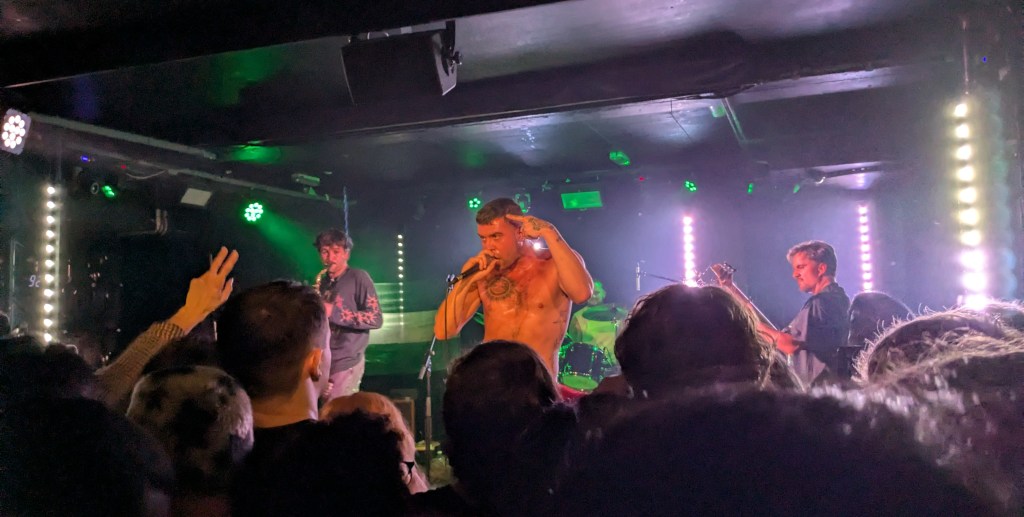
| Artist | Maruja |
| Venue | The Wardrobe, Leeds |
| Date | 7 November 2025 |
| Opener | Bloodsport |
| Closer | Reconcile |
| Highlight | They Look Down On Us |
| Undertone rating | 5/5 |
Last year in Newcastle Maruja were great, but now with a brilliant debut album under their belt the Manchester experimental rock group are truly astounding. Equally capable of fiercely political belters and quiet moments of spiritual transcendence, never has a gig made me feel quite so much.
The cloakroom attendant at The Wardrobe looks nervous. After dropping off my bag I make a move towards the venue entrance – the enticing rumble of support act Nerves already emmanating from the closed double doors – when she stops me. “Take a picture,” she says. For a moment I don’t understand, then I realise she means a picture of my cloakroom ticket number. “You might lose it,” she cautions as I get my snap before having my wrist stamped by a security guard and passing through those double doors and into the cacophonous interior of the basement venue. It feels like I’m going into battle.
The attendant has a point when it comes to losing hold of your cloakroom ticket – this is Maruja we’re dealing with after all, the latest in a long lineage of Mancunian hardcore punk bands whose reputation for notoriously rowdy live performances precedes them. When I caught them last November in Newcastle I had the privilege/misfortune of being flattened by saxophonist Joe Carroll, who had no qualms launching himself from the stage onto the crowd despite the Cluny being half empty. Tonight when he attempts the same feat there’s no risk of him hitting the floor again – the sunken den of The Wardrobe is packed full of mostly young men looking for the first excuse to whip their shirts off, and when the moment comes Carroll is promptly whisked around the room by a sea of hands.
Indeed, it’s Carroll who’s responsible for one of Maruja’s several distinguishing features from the plethora of other noisy rock bands summoning chaos at the moment in the UK and beyond. His aggressive sax playing is front and centre throughout the band’s extraordinary debut album Pain to Power, which was finally released in September some 11 years after the band first formed. His playing isn’t exactly technically outstanding – he won’t be competing with the likes of Nubya Garcia or Emma Rawicz for improvisatory prowess – but he is perhaps the best in the game when it comes to honking out a powerfully simple melody at supremely high volume. He’s also plenty charasmatic enough to be a frontman in his own right – he offers us a cocky smirk after almost every note in the droning opening to Zeitgeist, and he’s puppyish when hopping into the crowd for some theatrics before Thunder. “Leeds, are you ready?!!” he screams from the centre of the room after silencing the crowd as if he’s in some Yorkshire-based redux of Braveheart. It’s silly (and, with the rest of us pressed crotch-to-crotch at the side of the room, a little overlong) but, as with everything Carroll does, delivered with complete conviction. When the two walls of bodies finally collide under intense strobe lighting, the result is utter carnage. Having retreated back to the stage just in time, Carroll is left to look on, seemingly happy with his handiwork.
But Maruja isn’t Joe Carroll’s band – it is, undeniably, Harry Wilkinson’s. The vocalist is a stupendously compelling frontman, spitting out ferocious poetry into the faces of front-row fans before bellowing soprano wails into the mic with operatic panache. Every word he utters – even the clichéd ones about universal love, or obvious ones about the ills of late-stage capitalism – is delivered as if channelled straight from the depths of his soul. Every thing he does – raising his fist to the air, frantically gesturing to the mosh pit as if literally stirring us up, wailing into the mic as if in tears – is riveting. Wilkinson may on first impressions seem your stereotypical hardman (he too can’t resist ripping off his top for long), but it’s really his vulnerability and emotional range that blows you away. One moment he’s preaching “love in abundance” and the spiritual oneness of the universe, the next he’s yelling “OPEN UP THE FUCKING PIT!”. As an audience member you don’t know whether to laugh or cry, clench your fists in rage or jump for joy. Oftentimes you feel it all at once.
Pain to Power‘s lyrics can occasionally feel hackneyed and pseudo-intellectual, but tonight is no time for pondering on each of Wilkinson’s rhyming couplets. Instead, it’s all about feeling. They open with the new album’s more accessible punk numbers Bloodsport and hip-hop leaning Trenches, the former of which has the crowd in a frenzy in a matter of seconds. Cue the usual mosh pit tales: a woman in front of me appears to hit the deck but is promptly hauled up to her feet by the people surrounding her; a man loses his shoe, and the crowd cheers when he is finally reunited; I take a few stray blows to the back of the head and the occasional sharp elbow to the chest, especially during the death rattle of electronics at the end of Break the Tension. It’s a rock music cliché to say a song sounds like a sucker punch, but several songs tonight literally leave the crowd reeling. Born to Die, for instance, with its exhilarating funk-rock masterstroke of a finale, finishes with a brief stunned silence from the audience, who spend a good 30 seconds after the song stumbling into each other whilst struggling to regain their balance.
Indeed, Maruja are a band well-versed in punk’s unholy union of violence and love. In their best song, the cinematic epic They Look Down On Us, there’s plenty of both. “They try to blame the immigrants,” Wilkinson tells us in one moment of silence. “But we know it’s the billionaires!” The crowd cheer, and the rage at systemic injustice mutates into Matt Buonaccorsi’s bowel-rapturing bass line, which sounds about as colossal as two planets colliding. But then comes the bridge, and the band changes gear: Carroll whispers out a mournful sax melody, the imperious Jacob Hayes settles down to a simmer on the drums, and Wilkinson proclaims that “love is my God” and that we should “turn pain to power, put faith in love”. There’s always been something vaguely religious about Carroll’s sax melodies, which recall haunting Jewish klezmer music, but tonight Maruja’s implied spirituality is impossible to ignore. As Wilkinson pours his soul into the microphone, audience members spontaneously lift up their fists or burst into applause as if enraptured. I’m reminded that churches and concert halls aren’t much different after all – we’re all just hoping to tap into some higher power. There’s a sense of holy communion when Wilkinson follows the song by instructing the crowd to hold up their fists up in solidarity for “global oppression” in Sudan, Palestine and beyond. His preaching of humanity’s “oneness” can risk sounding airy-fairy at times, but in that silent minute of togetherness it all makes complete sense.
But it’s Saoirse that will linger with me most. It’s perhaps the band’s most tender song, Carroll fluttering delicately over Buonaccorsi’s lyrical bass wanderings. The wordless melody is so beautiful that the man to the right of me feels compelled to throw his arm over my shoulder. I in turn offer my arm to the man to the left of me who smiles and reciprocates, and suddenly I find myself in a long line of concertgoers (incidentally, all men) locked arm in arm, simply swaying in time to a gorgeous piece of art. The words we’re singing – namely, “It’s our differences that make us beautiful” – are undeniably trite, but for these few minutes not one of us shies away from belting them out anyway with genuine emotion. It’s the sort of vanishingly rare male vulnerability you might only otherwise witness at a football match. I’m sceptical when people claim that music really has the power to fundamentally change society for the better – most of the time I’m satisfied with just a catchy tune and a reason to dance. But Saoirse‘s moment of healing and the extraordinary sequence of songs that surrounded it changed my mind. Maybe art like this really can change the world.
 Undertone
Leave a comment