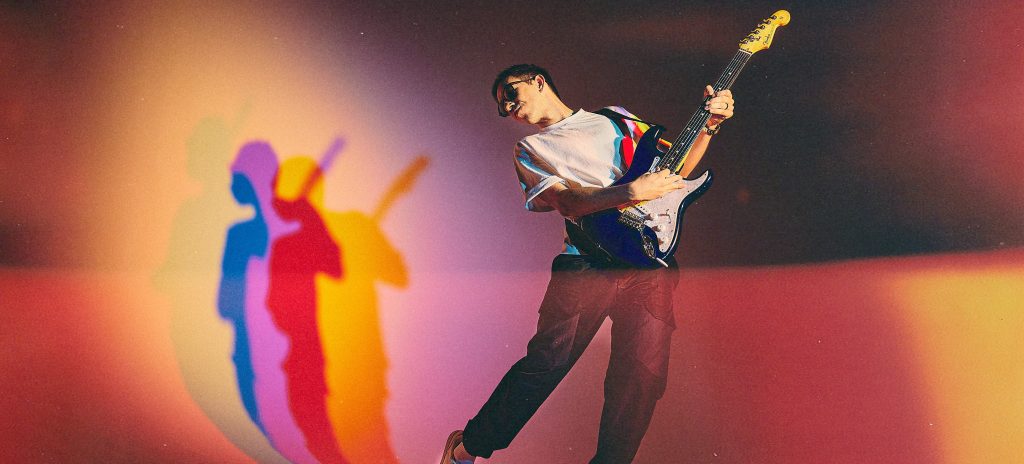
Image credit: Taichi Nishimaki
| Album | Lost In The Wonder |
| Artist | Cory Wong |
| Released | 3 February 2026 |
| Highlights | Lisa Never Wanted To Be Famous, Stay With Me |
| Lowlights | Tongue Tied, One Way Road, The Big Payoff |
| Undertone review | 2/5 |
Known for his signature guitar riffs, superhuman turnout of albums, and wider collaborative efforts, Cory Wong is well-established within the funk sphere. But with his latest release he’s perhaps gotten too comfortable, suggests Matthew Rowe.
Recently I had the opportunity to listen to Cory Wong‘s latest work, Lost in the Wonder, prior to release, a chance I instantly leapt at and was incredibly excited to cover, but was left with a lingering feeling of mediocrity at the end of the 12-song stretch. This is especially frustrating considering the incredible crew Wong had with him, including saxophonist Alex Bone and legend of the scene Sonny T, who formerly played bass for Prince.
The direction taken by this album is a weak point, leaning much more heavily into pop-centric, electronic songs. Wong has built up a reputation for hard-hitting funk, and while it is important to expand your genre range, it feels as if his musical identity is forgotten. The result is a series of disconnected singles as opposed to a solid album, with a lack of cohesion and a loss of what makes Wong’s music great.
Lyricism has never been at the forefront of his music, but throughout the album the lines chosen are shrouded with genericism and the cheesiness you expect from an American high school film. One example of this is in the song Tongue Tied, one of the pre-release singles. Listening to this gave me instant whiplash to Vulfmon’s How Much Do You Love Me, and it is packed with the most simultaneously radio-friendly yet cringeworthy lines. These include gems such as “I love you / I mean, hey, hi”, which feel like a crime to have to listen to. A Wong solo attempts to salvage this song, but you can’t put a plaster over a musical amputation and expect it to be fine.
These creative decisions, as well as much more generic instrumentals, make for a switch-up from the usual high-energy, guitar-driven and creative portfolio Wong is known for. Throughout the album, Wong’s guitar is also mixed fairly quietly, meaning that he only audibly appears for solos. The magic of his earlier work comes from the energetic backbone, allowing him to easily fall in and out of solos and giving his bandmates the space to shine while maintaining his signature musicianship. Solos deployed throughout do make for individually strong sections, but are not enough to outweigh the weak arrangement surrounding them.
Not all is bad, however, the album starts strongly with some very decent openers, namely Stay With Me and Afterglow. These set the precedent of an energetic album with plenty of dynamic instrumentalism. The first song, featuring Stephen Day, does suffer from the genericism mentioned earlier, but has an excellent horn section, with Bone showing why he was voted BBC Young Musician of the year. Afterglow is the first of the electronic tracks, featuring ellis and Elysia Biro. The rest of the electronic tracks should take notes from this one, as Wong’s guitar is mixed perfectly, the beat complements Biro’s voice perfectly, and it does not drag on more than it needs to.
The album can then be divided into three personal subsets. The first of these is where the electronic direction goes off course and backfires. Blame It On The Moon features Magic City Hippies and starts with the instantly recognisable Never Too Much lick from Luther Vandross, so you expect it to be a strong piece. This is unfortunately completely overwhelmed when the Hippies come in with highly autotuned vocals, which, when combined with harsh synths, do not complement the song at all. The Big Payoff is the second ellis tune. The name suggests that there will be a large build-up before a satisfying drop, but this is simply untrue. This song fails by going on for much longer than it should, leaving the listener questioning how long it will actually continue.
The second subset contains songs that are extremely cliché and hard to listen to; this includes the previously mentioned Tongue Tied, One Way Road, and All Night, Alright. None of these songs did anything for me, jam-packed with phrases such as “Where there’s lightning there’s thunder” and sounding like they could be background music to the most generic Netflix show you have ever watched. In Wong’s past, he has collaborated with many musicians, often within the funk sphere, and they have been consistently strong, but when it is paired with the addition of pop-based artists, the clash in styles is clear to see.
On the tail end of the album, Wong is joined by Vulfpeck’s Theo Katzman for a much more stripped-back breath of fresh air. Lisa Never Wanted To Be Famous has that classic Katzman feel, sounding like it belongs much more on one of his projects. Instantly, this song grips you with much more heartfelt lyrics, providing a much-needed balance to the others, even featuring Joe Dart’s sweet sweet basslines. Alongside the solemnity, there is plenty of groove, half forcing me to be lost in the wonder of how the rest of the album couldn’t replicate this. This also makes for a second song covering the Mona Lisa by the Vulfpeck collective, and I wonder if we will hear more on the saga.
As someone who has been a long-term supporter of Wong’s music, it is disappointing to see how he tackled this project; between rogue choices of genre and mismatched collaborators, it has resulted in a disconnected collection of songs that do not constitute an album. Despite the few positives, the overall lacklustre performance overpowers and we are left with this. Given how solid of a live performer he is and how much solid work he has put out, I hope we see an improvement soon.
Lost In The Wonder by Cory Wong is released 3 February 2026.
 Undertone
Leave a comment