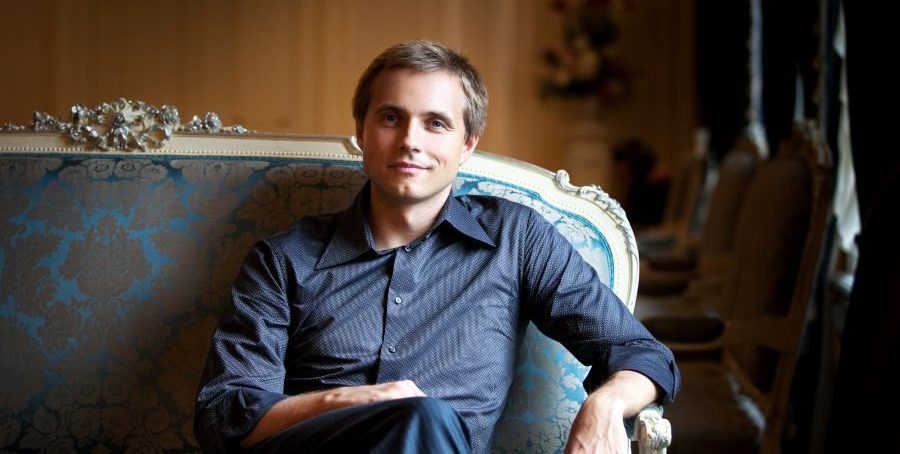
Image credit: The Glasshouse ICM
| Ensemble | Royal Philharmonic Orchestra; Vasily Petrenko (cond.); Tom Borrow (piano) |
| Programme | Symphony No. 10 (Shostakovich); Piano Concerto No. 1 (Tchaikovsky); Kikimora (Liadov) |
| Venue | The Glasshouse, Gateshead |
| Date | 8 February 2026 |
| Undertone rating | 4/5 |
Tom Borrow’s solidly unassuming rendition of Tchaikovsky’s First Piano Concerto was a little heavy-handed, but nonetheless a worthy scene-setter for Shostakovich’s whirlwind Tenth Symphony, a timely piece about Stalin’s authoritarian regime that sounded viscerally shocking under Vasily Petrenko’s assured baton.
It’s not immediately clear that Tom Borrow realises what’s going on. He strolls out onto the stage of a rammed Glasshouse, weaving between a forest of microphone stands (a BBC Radio 3 recording is forthcoming, as one excited concertgoer later tells me in the interval) before plonking himself on the piano stool and hunching back patiently as the opening orchestral strains of Tchaikovsky’s Piano Concerto No. 1 creak into gear. This should be a moment of dignified poise, but instead his demeanor is more like he’s comprehending bashing out a bit of The Winner Takes It All at his local train station piano, one foot tucked underneath his stool as if anticipating a mad rush for the 1532 to Carlisle.
Luckily, it turns out Borrow is happy to linger this time, doling out the concerto’s famous opening refrain with occasional cursory glances to his side as if he’s only just noticed the 80-piece Royal Philharmonic Orchestra in full flow beside him. His demeanor may be a little dazed and confused, his playing is anything but: Tchaikovsky’s spine-tingling, filmic introduction is given the robust treatment it deserves, Borrow’s soaring top line every bit a match for the graceful flock of violins that soar alongside him. It is a powerful start, but also an open goal for Borrow and RPO’s resident conductor Vasily Petrenko – this is the sort of uncomplicated, straight-to-the-heart pop-classical material that is quite difficult to ruin with a poor rendition.
The bigger challenge for Petrenko and Borrow was to make sense of the subsequent 30 minutes. Bafflingly, that opening refrain leaves and never returns – perhaps one reason why Tchaikovsky’s first choice of pianist detested the concerto so much he pointedly refused to play it – and instead the composer proceeds with a smorgasbord of tangentially related ideas. Tonight Borrow is the anchor, wave after wave of notes sweeping up the full length of the keyboard like curtains of rain. There are glimpses of tenderness in his rendition of the delectable middle movement – caressing some delicate, wind chime-like arpeggios in the upper register during one particularly crystalline moment of calm – but there’s a sense Borrow is really just here for that rollicking third movement. When he gets there, he leaps onto the sprightly, folky refrain with boyish enthusiasm, shuffling impatiently in his seat in between each knotty burst of notes. In the end, perhaps it all gets a little too much – a heavy sustain pedal muddies the water somewhat in some of his mazy runs, and he finds himself rushing ahead of Petrenko in the lightning quick finale, the concerto collapsing in on itself. It’s a slightly fluffed finish but Borrow’s face doesn’t show it as he takes three seperate curtain calls, then begins Bach’s famous Sheep may safely graze for a refreshingly un-virtuosic encore, Borrow’s considerable talent as a concert pianist shown not in the technical difficulty of the piece, but his knack for shining light on the inner voices hidden behind the ringtone-worthy refrain.
The main meat of tonight’s programme, though, comes after the interval. Dmitri Shostakovich’s Tenth Symphony was the first he wrote after the death of Stalin, at last free of the fatal risk that the dictator would deem his new music too ‘bourgeoisie’ for Soviet society, an extreme artistic restriction the composer had contended with – and occasionally fallen foul of – his entire career. Shostakovich himself insisted that the Tenth was a no-holds-barred account of the erstwhile Stalin regime, a shapeshifting blur of jagged melodies and haunting motifs that reflected on the immense terror and brutality of the preceding 30 years of Russian history. Tonight’s performance could hardly feel more timely – it’s conducted by a Russian and preceded by an Israeli pianist, but it’s the emerging American regime that feels most obviously reflected in RPO’s repertoire choice.
As a stark reminder of just how bad authoritarian regimes can get, Petrenko and his orchestra stated their warning more powerfully than any formal speech or collection of facts could. This is a symphony you feel in your gut. At times the rabid strings evoke a panic attack, the violinists wielding their bows like daggers, which often audibly slap against the instrument’s body, such is the ferocity of RPO’s attack. Brass blares, double basses brood, and the percussion section often deafens, the xylophone punctuating every fresh onslaught of strings. Stephen Quigley is the lynchpin on the symphonic gong, an overwhelming presence during the fortissimo passages but ghostlike and wispy for the symphony’s many quiet back alleys of intrigue. Lesser conductors might be inclined to throw their arms wildly and leap from the podium in the midst of Shostakovich’s Stalinist storms, but Petrenko admirably keeps a lid on things, well aware that this symphony is about much more than just shock factor. As a result, the minimalistic quiet sections also sound sickeningly intense, every moment of tranquility paired with the sense that a monster is always lurking just around the corner. The only blemish in Petrenko’s measured approach is perhaps how he handles the lurid marching band that shoulders its way into the third movement, a moment of provocative black humour from Shostakovich, but tonight too understated and slow to be the sardonic grin at the waning Soviet Union it ought to be.
The odd thing about Shostakovich’s Tenth – a symphony expressly intended to condemn the hubris of one very powerful man – is how egotistical it is. Shostakovich’s signature motif used throughout his career (which follows the initials of his name: D-Es-C-H, or D-Eb-C-B to me and you) pops up more and more in the final two movements. Tonight Petrenko keeps it insistent and unmissable; the earworm still loops around in my head as I leave the venue. In the narrative of the Tenth Symphony, Shostakovich casts himself as the hero (alongside his female pupil Elmira Nazirova, who also gets an initials-based motif) triumphing over the powers that be with this signature motif that comes to dominate the entire orchestra in the audacious finale. Whether it’s a moving symbol of individual victory over a soulless regime or a moment of hyprocritical hubris depends on your point of view. Still, it’s hard not to be awed by RPO’s delivery. Triangles trill, strings scintillate, the timpani sound like a rocket taking off. After 53 minutes of musical terror, this is our two minutes of giddy jubilation. With a final flick of the wrist Petrenko summons a final skywards lurch from the strings, the brass roaring, all five percussionists hammering away at their respective instruments. It’s thunderous, but the applause is louder still. This symphony had been not just thought-provoking and timely, but also simply a feast for the ears.
Read more classical reviews on Undertone here.
 Undertone
Leave a comment