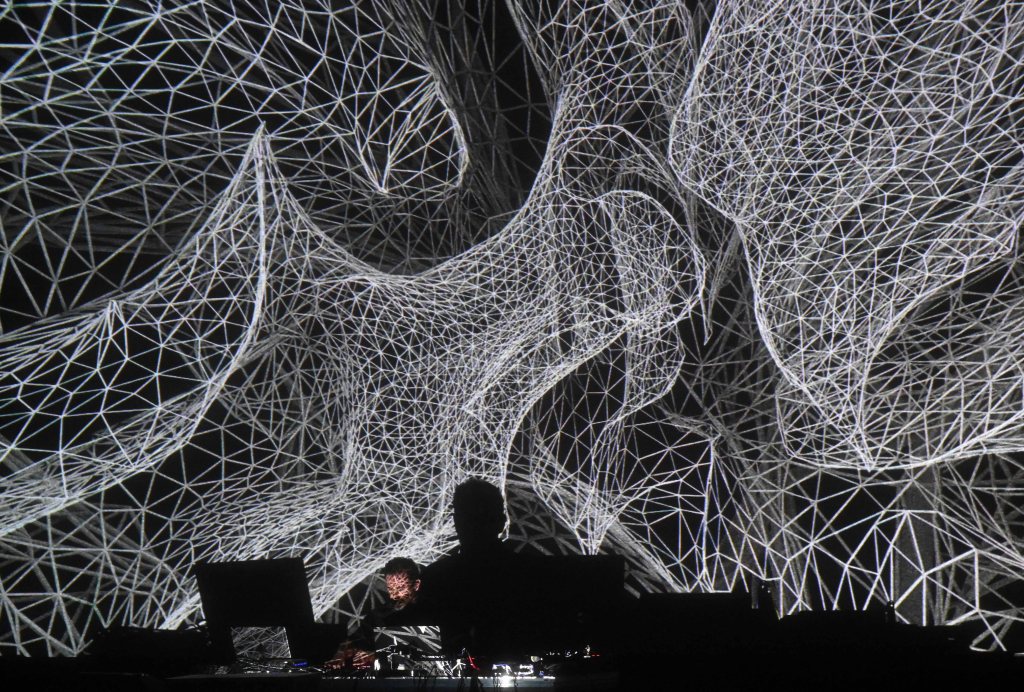
Image credit: Barry Pells; The Glasshouse ICM
| Artist | Max Cooper |
| Venue | The Glasshouse, Gateshead |
| Date | 21 May 2026 |
| Opener | Chrysalis |
| Closer | Perpetual Motion |
| Highlight | Obsessive Compulsive Order |
| Undertone rating | 3/5 |
Music plays second fiddle to visual art in Max Cooper’s impressive 3D/AD Live show, the performer partly obscured behind a screen of dazzling technicolour projections. When the shapeshifting art is the right fit for Cooper’s cerebral electronica, the result is transfixing, but this meandering show seems to be missing its guiding light.
More than any other genre, electronic dance music is unsuited to the stage. DJ shows tend to involve a lone producer (usually an average-looking bloke in his forties who spends too much time indoors) dwarfed by a giant stage, cowered over a mixing desk where it’s never particularly clear to the audience what he’s actually doing with all those knobs and sliders, if anything. DJs are an aloof and perhaps slightly shy bunch, disconnected from their audience by distance and giant over-ear headphones, preferring to splice together pre-recorded material rather bearing all into a microphone. In terms of visual appeal, if pop and rock are musical equivalents to football and rugby, EDM gigs are music’s chess: esoteric, static, and frankly a little boring.
The solution, of course, is lights, lights, and more lights. Whilst some DJs may use lights to highlight themselves – giant LCD screens showing the performer at work, pyrotechnics to frame the mixing podium – Belfast-born Max Cooper has taken the radical approach of putting the projections front and centre. He is not just a techno producer, but a “multi-disciplinary artist” as his website puts it, and his already renowned 3AD Live show partially conceals the artist behind a translucent screen of projections. Tonight’s set is perhaps more accurately described as a piece of visual art than a concert; it would feel just as at home in the Baltic contemporary art gallery down the road as it does in tonight’s venue of the Glasshouse.
It’s telling that, unlike for Cooper’s Canadian contemporary Caribou, tonight the usual padded seating is installed in the Glasshouse’s main auditorium. Cooper’s work is less dance music, more scratch-your-chin-and-nod-thoughtfully music, instrumental tracks which gently sweep in and out of focus over the course of five or ten minutes, and which proclaim to tackle such lofty topics as “the relationship between physical form and human emotion”. His PhD in computational biology may sound surprising at first, but tonight the link is obvious in the technically dazzling projections of quivering amoeba and shimmering jellyfish shoals.
Tonight it’s 10 minutes before we get our first colour that isn’t white, and another 10 until the music finally gets a clear pulse. It’s patient to the point of patience-testing, but as the night develops it’s the visuals that keep things intellectually stimulating. Cooper is not entirely averse to the clichés of natural, mathematical beauty – the golden ratio, starling murmurations, a few laboured lens flares – but more often tonight the art delves into fascinating new territory. Pattern Index brilliantly finds natural beauty in the time-lapsed cityscape of Hong Kong, hidden geometric forms emerging in repetition from ostensibly ugly human architecture. A Sense of Getting Closer conveys a very modern capitalist dread with its endlessly expanding torrent of advertisements, whilst The Shape of Memory manages to capture just that with a patchy, ghostlike 3D rendering of a real wedding.
The digital art pieces are not without the occasional clunker (one track makes a heavy-handed anti-technology argument by way of emojis and stick figures distracted by their phone screens), but the deeper issue with this show is a lack of cohesion. If there’s a narrative thread through Cooper’s pieces about biology and architecture and technology and capitalism and metaphysics, I lack the necessary PhD to discern it. Musically, Cooper’s near-complete aversion to melody eventually begins grate, and without any hooks to hold on to, his constant stream of warm, soft-edged synths outstay their welcome as this gig drifts towards the two hour mark. Instead of melody, percussion seems to be Cooper’s main musical interest, and tonight’s most memorable tracks all feature fabulously complex drum machine grooves. Stuttering Bass Mosaic is deliciously dark and penetratingly loud – I can feel the bass vibrate through my seat. The highlight is Obsessive Compulsive Order, an amazingly detailed percussive opus that’s paired with flashing waveforms and e-reminders on screen that evoke Cooper’s frenetic, ingenious creative process. Listen to it in the best headphones you can find and be awed by Cooper’s Ableton Live mastery.
Tonight’s crowd in the Glasshouse are fidgety – barely a song goes by without someone on a row in front of us heading for the bar – and perhaps you can’t blame them for it during this overlong set, which lacks the tried-and-true hits and singalong moments that would keep a normal gig engaging. It’s telling that only during the encore – a remix of Perpetual Motion, and the only song of the night with an undeniable melodic hook – do the crowd finally start whooping along and dancing, and at last the music takes precedence over the visuals. Up until that point, however, Cooper’s songs had a tendency to dawdle. His show had been complex, thoughtful, and intellectually stimulating but, at the end of the day, sometimes you just want to hear a hit.
 Undertone
Leave a comment