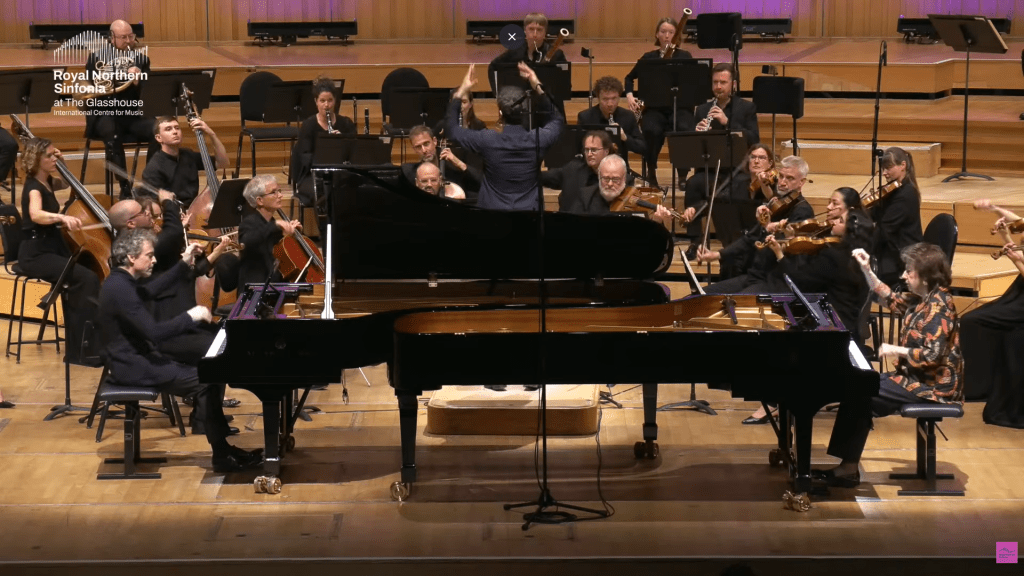
| Ensemble | Imogen Cooper (piano); Paul Lewis (piano); Royal Northern Sinfonia; Dinis Sousa (cond.) |
| Programme | Piano Concerto No. 27; Don Giovanni Overture; Piano Concerto No. 10 for Two Pianos; La Clemenza di Tito Overture (Mozart) |
| Venue | The Glasshouse, Gateshead |
| Date | 13 June 2026 |
| Undertone rating | 4/5 |
Returning to the same composer that started her career over five decades ago, Imogen Cooper’s farewell concerto was an uplifting Mozart masterclass. Her duet with Paul Lewis was entertaining and Dinis Sousa was as lively with the baton as ever, but it was a nuanced 27th Concerto that best highlighted Cooper’s talent as one of Britain’s finest concert pianists.
Imogen Cooper leans back on her piano stool and slowly scans the room. She’s in the middle of the very final concert of her expansive career on British soil, contemplating the exquisite Larghetto from Mozart’s Piano Concerto No. 27 before caressing the first few delicate chords. In 15 minutes she will hammer out a final major chord and the standing ovation from this adoring Glasshouse audience will be long and rapturous. Tonight she has an air of magisterial calm but, if only for one brief moment in between movements of her final performance, it seems the emotional weight of this occasion may be dawning on her.
It’s been over 50 years since Cooper made her debut with Royal Northern Sinfonia in a church in Kendal, playing Mozart under the baton of the now superstar conductor Simon Rattle. It was Cooper who carefully selected the Glasshouse’s (then the Sage’s) first resident piano in 2005, even surveying the auditorium in a hard hat mid-construction to get a feel for this room’s superb acoustics. Tonight she in fact inaugurates a crisp new Steinway, the venue’s third piano after late director Lars Vogt chose his, which conductor Dinis Sousa christens as “Imogen the Second”, to the audible approval of the audience.
This is Cooper’s leaving do, so Sousa’s piano-free performances with the RNS are kept necessarily brief, with a Mozart overture to kick-start each half with his customary vim and vigour. This really is the sort of full-bodied orchestral music Sousa and the RNS eat for breakfast – La Clemenza di Tito’s regal opening chords sound firm but never overly serious, Sousa skipping rather than stomping his way through the piece’s flamboyant symphonic flourishes. The Don Giovanni overture at the start of the second half is similarly an espresso shot of a piece, Sousa testing the seams of his tailored suit jacket as he launches his whole upper body into the famous opening D minor chord. RNS’s dynamism, particularly in the strings, remains a pure thrill, even the quieter sections fizzing with excess energy. I must have seen them at least a dozen times now, and they are yet to disappoint.
The main course of tonight’s programme starts with Mozart’s 10th piano concerto, an oddity in his repertoire written for two pianos, with Paul Lewis playing secondo tonight for a novel and entertaining rendition. With the two pianists looking directly at each other, this was all about the playful musical conversation between the two soloists. Mozart composed the piece to perform with his sister Nannerl, and there is indeed a frisson of sibling chemistry between Cooper and Lewis’s intertwined playing tonight, fluttering scales and bubbly arpeggios bouncing seamlessly from one piano to the next. That said, if they are pianistic siblings, it must be said that Cooper and Lewis are unusually polite ones; the call-and-response duels in the Rondo in particular feel overly cordial and restrained. You want the pianists to relish in one-upping each other with ever more pristine flourishes. Instead, they’re happy to settle for a score draw tonight.
It’s Cooper’s rendition of Mozart’s 27th piano concerto, though, that will live longest in the memory. No. 27 forms part of the composer’s late era when, despite his increasingly unhinged antics outside of music, there was a sense in the pieces that beneath the noise and the outward joviality he was quietly contemplating his own demise. This work features the usual bright, forthright melodies you’d expect in any Mozart concerto, but also subtle, vaguely unsettling glimpses of melancholy. It is an inspired repertoire choice for tonight’s occasion, evoking both the celebration of Cooper’s long and successful career at the keyboard, and perhaps some sadness at departing the concert stage for the final time. Tonight Cooper’s rendition is alive to both contrasting moods, fleet-fingered major scales juxtaposed with that delectable slow movement, in which Cooper’s delicate tone reaches towards pearly perfection. The final movement reworks Mozart’s poignant song Longing for Spring for an orchestral setting. It is bubbly and vivacious, but also touching, the usual bluff and bluster of a concerto finale replaced with gentle lyricism. Cooper’s rendition is thoughtful and clearly deeply felt but never melodramatic. After all she is, and always has been, a consummate professional.
Being the last concert of the 2025/26 classical season, tonight also happens to be my last Glasshouse concert for the foreseeable future after four happy years of living in the North East. I’ve reviewed scores of venues on this blog, but this one remains my favourite, a jewel on the Tyne where I’ve experienced some of my most wonderous musical experiences (Víkingur Ólafsson’s tearjerker encore, Ichiko Aoba’s dreamlike evening and Self Esteem’s life-affirming poetry come to mind). Tonight’s performance is preceded by a speech from new Glasshouse chief executive Fraser Anderson. “It’s probably the finest concert hall for live music and music education in the country,” he tells us. It’s PR talk, sure, but on this occasion I can only agree wholeheartedly. I will miss this church of music.
This full concert is available to watch on YouTube here until 13 July 2026.


Leave a comment