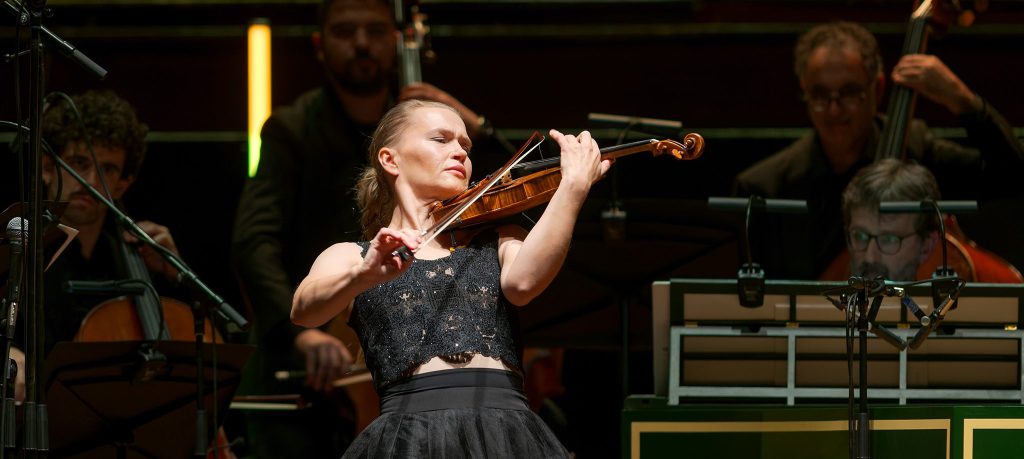
Image credit: Christopher Bowen; SCO
| Ensemble | Scottish Chamber Orchestra; David Brophy (cond.); Mari Samuelsen (violin, dir.); Chris Ekers (sound) |
| Programme | Opus 2020 (Richter); Company (Glass); The Chairman Dances (Adams); Recomposed by Max Richter: Vivaldi – The Four Seasons (Richter) |
| Venue | City Halls, Glasgow |
| Date | 23 October 2026 |
| Undertone rating | 3/5 |
A vivid rendition of Richter’s ingenious tribute to the Four Seasons was the clear highlight of this forward-thinking programme of living composers in Glasgow’s City Halls. Before the interval, self-assured conductor David Brophy sounded most at home animating John Adams’ colourful The Chairman Dances.
It’s just gone 7.30pm at Glasgow’s elegant City Halls, and David Brophy has a mischievous glint in his eye. He starts by cueing a brief rustle of auxiliary percussion before turning to the audience. “A kick drum. Two sandpaper blocks. A snare drum played with a wire brush. It’s not what you expected, and it’s certainly not Max Richter’s Opus 2020.” The audience let out a confused chuckle. It is in fact, as Brophy goes on to explain, the final passage of John Adams’ The Chairman Dances, and the beginning of a charismatic and immaculately rehearsed opening monologue from Brophy. He prefaces the “murky, nebulous” would-be first piece Opus 2020, and the relative terra firma of Philip Glass’s Company, before pointing out how that initial percussion passage uncannily mimics the sound of a gramophone reaching the end of its disc. Before the strings players have even lifted their bows, it’s clear we’re in safe hands tonight.
Brophy’s entertaining MCing aside, Richter’s ambient Beethoven tribute Opus 2020 makes for a curiously lowkey start. It is an intentionally amorphous piece, but there’s still a sense the SCO could find more tonal shape in the course of a ponderous 18 minutes, the strings sounding all too tentative and one dimensional. Lousie Lewis Goodwin possesses the necessary zen mentality for the delicate yet crucial timpani ostinato, but Michael Bawtree’s piano solo makes for a plodding finish. Brophy called Richter’s decision to replicate Beethoven’s Piano Sonata No. 30 note for note to close Opus 2020 “a self-effacing move”. Others may call it a cop-out.
It’s a relief to arrive on the aforementioned solid ground of Philip Glass’s Company, but the SCO really start taking off during The Chairman Dances. A foxtrot recounting Mao Zedong’s obscene sexual escapade at a presidential banquet, here the ensemble sounded appropriately zany and unpredictable under Brophy’s baton, distantly swirling strings erupting into a frenzy of brash almost-jazz at a moment’s notice.
After the interval, Norwegian violinist Mari Samuelsen takes the reins for tonight’s main course of Richter’s recomposed Vivaldi. It’s hard to think of a living composer that straddles both commercial and critical acclaim as comfortably as Richter. His streaming hit On the Nature of Daylight came to fame on the soundtrack of Hollywood blockbuster Arrival, but is so potently moving no one seemed to complain when Chloe Zhao recycled it for the emotional crux of 2025’s Hamnet. Yet his beautiful ballet Infra and innovative 8 ½ hour opus Sleep even get the seal of approval from the same high-brow music critics who scoff at Richter’s prominent contemporaries like Ludovico Einaudi or Hans Zimmer.
Recomposed is therefore classic Richter. Sure, all those irresistible ditties you’ve heard from being put on hold to your local GP are bound to have mass appeal, but Richter’s new smattering of electronics, stuttering time signatures and minimalist bass lines also offer plenty for listeners tired of hearing retreads of Vivaldi’s 300-year-old path. Tonight Chris Ekers has even more responsibility than your typical sound guy, piping in pre-recorded beds of strings during the opening movement. He also has to get a handle on Samuelsen’s amplified lead violin, which sounds metallic and grating during Spring but settles as the symphonic year progresses. A bigger, less controllable sound issue comes from the audience: someone is apparently playing football commentary on their phone for the entire recital, sounding clear as day during each gap in movements. Samuelsen can surely hear it too, but if she’s frustrated it only seems to add to the vigour in which she launches into a furious summer storm, her shrill three note refrain as thrilling as any virtuosic cadenza.
Richter was wise to preserve, as Samuelsen prefaces, “the 25% best bits” of the original, and Autumn’s opener still sounds prim and bouncy with the help of Bawtree’s harpsichord. On top of that, Richter capitalises on Vivaldi’s gift of imagery: the heavenly birdsong and double bass sunrise in Spring, Summer’s drowsy afternoon, the crisp crunch of leaves in Autumn’s third movement. The highlight is an impossibly icy Winter, the stage bathed in a deep blue and the ensemble belting out Vivaldi’s anthemic refrain in all it’s stadium rock glory. Samuelsen, undeterred by the latest Ipswich v Nottingham updates, is on imperious form, crossing the stage for a quick duel with the cellos before unleashing another violin blizzard at centre stage.
She finishes the final movement as she did the previous ones, bow hoisted high, fist aloft like the contemporary classical superwoman she is. Somewhere a tinny voice reports a late chance from substitute Jack Clarke. Tonight’s performance had its imperfections both preventable and otherwise, but the SCO really found their flow in the second half. A score 1-1 draw, I think.


Leave a Reply