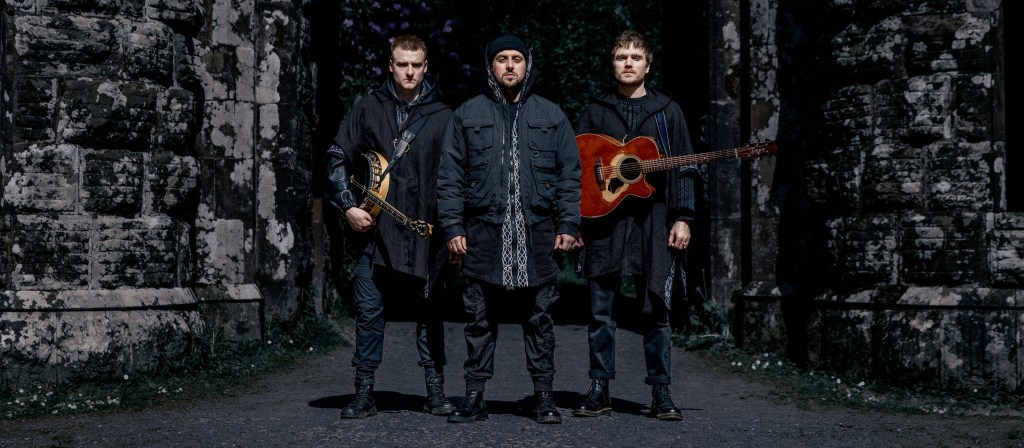
Image credit: @fargos_photos
The innovative Irish trio’s early career success came with hidden pitfalls, from being artistically pigeonholed to fierce backlash from trad music purists. They speak to Undertone about leaning on each other through adversity, the power of communal music-making, and Kneecap’s place in the history of Irish culture.
Chasing Abbey are men in demand. It turns out I’m not the only budding young journalist loitering amongst the grungy railway arches in Yorkhill as a freezing, crystal clear evening settles in this Sunday night. Band member Jonathan Byrne greets us promptly and politely at a side door, but the band – fresh from an exhaustive US tour and set to play to a headline set in the spacious SWG3 Warehouse in a matter of hours – are clearly on a strict schedule. We’re given 10 minutes each, and my fellow journalist graciously lets me enter an unglamorous side room to meet the band first. I exchange handshakes and promise to rifle through my page of notes as quickly as possible.
The fact Chasing Abbey have only recently released their debut album, Cyber Celt, belies the fact that their boundary-pushing blend of house music and spiritual Irish folk has seen huge success for nearly 10 years, especially in their native Ireland. The band’s 2017 debut single, That Good Thing, was a familiar yet catchy house track that was an instant radio hit, winning RTE’s coveted Choice Music Prize as the year’s finest Irish single.
That Good Thing’s crowd-pleasing electronic pop approach now sounds a world away from their more daring “trad house” genre blend, I note. Did the early accolades risk putting them in a box from day one? “For sure it was probably too successful for the level we were at in terms of our maturity and artistry,” frontman Ted Conway candidly admits, a warm presence clearly at ease in the role of band spokesman for these group interviews. “It put us into a box where we didn’t want to be for years,” he says. Chasing Abbey are, after all, old school trad musicians at heart, and the sound of those first singles felt so contrary to their alt-trad ambitions that they even considered ditching the Chasing Abbey name altogether. In the end, the band decided Chasing Abbey is simply “a collective of three artists that just follow whatever we think is fucking cool.”
‘Fucking cool’ turned out to be 2023’s single Oh My Johnny (Banks of the Roses), an innovative reworking of a timeless traditional tune into a pulsating dance track, complete with heavy synth bass, propulsive dance piano, and a prominent banjo hook. It was the band’s second viral hit, going certified platinum in Ireland, earning them a spot on The Late Late Show and a record deal with Warner Music. But once again, the success came at a cost, this time from folk purists outraged at the band’s sacrilegious attempts to repackage the genre for a modern audience.
“We were subject to a lot of abuse on TikTok,” Conway says. “It’s hard to look at a video that has like 20,000 likes but all the comments are slating you. It was a hard time for us. Luckily we could lean on each other and it made us stronger. The only thing we can control is who we are as people and the art we make, and if that’s how people want to spend their time I feel sorry for them honestly.” It sounds like the criticism perhaps even spurred them onto to explore their trad house sound further? “It definitely put the bit between our teeth – we were like ‘well fuck you, watch this’,” Conway laughs.
The result was Cyber Celt, a fascinating tour of Irish folk melodies and instrumentation, delivered via Conway’s austere and often chanted vocals. The record is hypnotic in its electronic bleakness, but not without the deep sense of community and history inherent in all trad music, best heard in the group chorus on thumping highlight Saoirse Saoirse (“Freedom Freedom”). “You know we’re quite spiritual people,” Conway remarks, something that seems to go hand in hand with the Irish pub trad sessions the band have frequented all their lives, where we goal is more about spontaneous social bonding rather than pop stardom or artistic perfection. “They’re one of the things we miss most on the tour. You don’t have a hangover after a session, your heart is so full.”
It feels like you can’t move for brilliant, world famous Irish acts these days. There’s superstars like the peerless Fontaines D.C. or one woman tour de force CMAT, as well as a clutch of fresh bands all taking the country’s rich music traditions in wild new directions: Madra Salach, Lankum, Gilla Band, The Mary Wallopers, Gurriers, to name a few. Why is Irish music resonating so widely? “Obviously the quality of the art is really good,” Conway says, “but I think the quality of the people behind the music is what’s really appealing to people in a world where there is so much wrong going on, it’s nice to be able to look at your favourite band and see that this person is standing on business, they’re not sold out to the industry, they’re standing up for human rights and they’re doing what’s right. I think Irish people have a moral duty to do that because of our history.”
Indeed, countless Irish bands have been outspoken in their support of Palestine in particular, not least trail-blazing Belfast trio Kneecap, who Chasing Abbey are good friends with (“lovely lads,” they assure me). Did Kneecap’s wild success in Irish-language hip hop (and high profile run-in with the British legal system) inspire Chasing Abbey? “It was a wake up call,” says Conway. “We thought if these boys in their circumstances are doing this well then, in our privileged circumstances down in the Republic, we need to be doing the same. It’s so important to keep the language alive – if the language dies, we lose so much culture. I think we’ll look back at what Kneecap have done in many years and maybe credit them for saving the Irish language.”
Chasing Abbey’s new album, largely sung in Irish, is certainly a part of the language’s recent cultural resurgence, but the trio have less lofty aims than history-making for the time being. “I think the ultimate goal is just to make great art, and if that happens to have a side effect of some success, well, that’s great. We want to make music that in 50 or 100 years people will throw on.” The more immediate future? “The minute we get back we’re going straight back to a trad session,” they laugh. “We’ve missed that.”


Leave a Reply