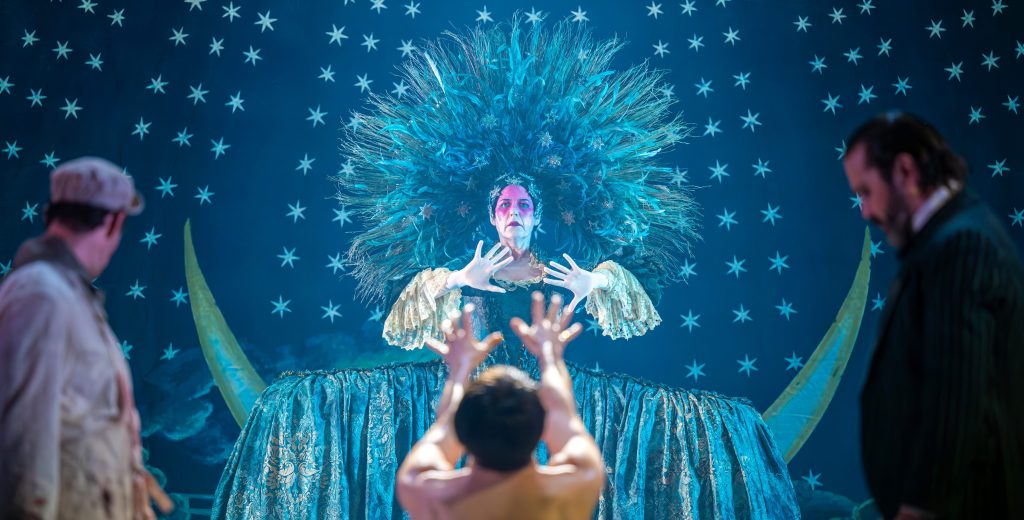
Image credit: Mihaela Bodlovic
| Ensemble | Scottish Opera |
| Programme | Turandot (Puccini) |
| Venue | Theatre Royal, Glasgow |
| Date | 22 October 2026 |
| Undertone rating | 4/5 |
Think Puccini’s swan song is just a vessel for opera’s megahit Nessun Dorma? Think again. Scottish Opera’s latest Turandot revival is sumptuous from start to finish, delivering both intimate anguish and knock-your-cotton-socks-off awe in equal measure.
Is opera on the way out? You’d be forgiven for assuming so. Arts funding in the UK has been on the slide for years now but opera, with its lavish productions full of elite specialist performers, is facing a tighter financial squeeze than most. Classical music’s loyalty to its canonical, centuries-old hits seems to have alienated a younger generation in need of something fresh and exciting (can you name a single 21st century opera?) and, despite many orchestral groups’ sterling efforts at offering heavily discounted tickets for young people, opera and classical music in general remains firmly uncool.
Most friends I asked hadn’t even heard of Nessun Dorma, the opera equivalent to Shape of You or Blinding Lights when it comes to commercial firepower – Pavarotti’s 1990 World Cup rendition staggeringly reached No. 2 on the UK singles chart. Many, I suspect, will know Turandot as The One With Nessun Dorma, but that magnificent aria is one all too brief morsel of an absolute feast of music and drama. The mass appeal Nessun Dorma may be a surefire way for a cash-strapped Scottish Opera to get bums on seats, but Turandot isn’t exactly a cheap win. The number of performers involved, for one thing, is staggering: 81 members of the chorus plus some 107 orchestra players (yes, I counted), not to mention a small army of backstage production staff. The result was a truly dazzling spectacle from curtain raiser to finale.
Perhaps Glasgow-born director Sir David McVicar’s boldest staging choice is in doing away with the traditional dynastic Chinese garb and colourful masks for a sort of post-apocalyptic roaring 20s set, complete with crumbling art deco backdrop and chorus members donning crystal headpieces and velvet top hats. The opulent decay is a shrewd fit for Halloween season, but also brings to life the dystopian world of Princess Turandot’s China, a land which she lords over with an iron fist. The entrance of Danish soprano Trine Møller’s Turandot is regal to the point of divinity. She sports an enormous gown and towering feathering headdress, wordlessly calling for the execution of the Prince of Persia, stark naked and on his knees begging for mercy. Ascendant music aside, it’s one of the most striking theatrical tableaux I’ve ever witnessed.
It’s not until Act Two that Møller’s mellifluous voice is unleashed, revealing hints of Turandot’s conflicted and traumatised heart beneath her icy exterior in several exchanges with Victor Starsky’s earnest Calaf. The emotional intensity is balanced out by charming turns from Ping, Pang and Pong (Josef Jeongmeen Ahn, Aled Hall and Luvo Maranti), whose slapstick buffoonery is complicated by their enthusiastic calls for Calaf’s execution. The audience shuffle with excitement before Starksy’s majestic Nessun Dorma at the start of Act Three, but the pick of the soloists is Hye-Youn Lee’s Liù, whose swan song Tu che di gel sei cinta sounds utterly heartbreaking before her shocking onstage suicide.
McVicar’s other bold move was to opt for Franco Alfano’s original extended completion of the opera (which Puccini mysteriously never completed) instead of Arturo Toscanini’s truncated version. It’s the first time Alfano’s ending has been staged in the UK, and tonight McVicar’s decision pays dividends, adding depth to Turandot’s inner torment without ever feeling surplus to requirement. If this production does slip up, it’s in the pivotal three riddles scene in Act Two, where the scores of chorus singers onstage feel too static, waiting around for their next chance to chink their glasses in honour of their princess.
But this Turandot is so enthralling and action-packed that such quibbles don’t live long in the memory. The finale, with Møller’s triumphant declaration of love and Stuart Stratford’s formidable orchestra belting out a reprise of Nessun Dorma’s stirring refrain, is the sort of art that sets butterflies racing through your stomach. This glorious, no-expense-spared production is solid proof that opera is indeed alive and kicking. It’s enough to make even the harshest cynic fall in love.
Turandot continues in Glasgow until 7 November, then Edinburgh until 22 November.


Leave a Reply